
*This post may contain affiliate links for which I earn commissions.*
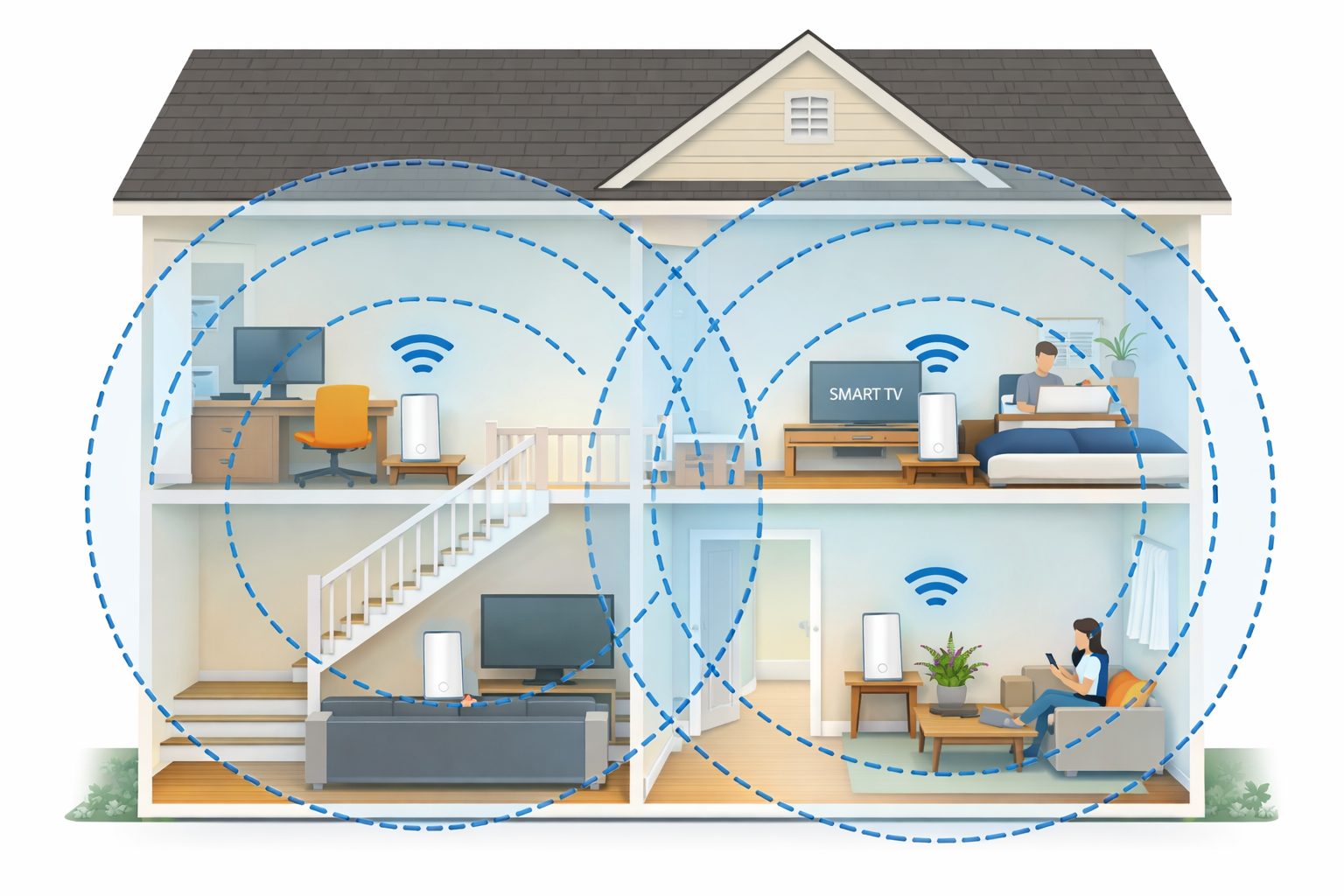
In most 2-story wood-frame homes, a properly placed tri-band mesh system (a system that uses three Wi-Fi bands to separate device traffic and node communication) with two nodes is sufficient to deliver stable upstairs coverage. The key is not maximum advertised speed, but strong backhaul (how nodes communicate with each other) between floors (see how backhaul works in mesh systems) and correct midpoint placement. Because Wi-Fi weakens more when traveling vertically than horizontally, Because Wi-Fi weakens more when traveling vertically than horizontally, node positioning matters more than brand selection (see how mesh WiFi systems actually work in real homes).
In homes with dense materials or concrete floors, wired backhaul (Ethernet connection between nodes) may matter more than upgrading to a higher-priced system. Most households do not need three nodes unless layout complexity or square footage significantly exceeds typical ranges.
Key Takeaways
- Two nodes are sufficient for most 2-story homes.
- Tri-band systems maintain stability better under load.
- Vertical signal loss is primary issue in multi-floor homes.
- Node placement matters more than square footage claims.
- Wired backhaul improves consistency across floors.
- Overbuying nodes can create overlap and instability.
Why 2-Story Homes Are Different
Wi-Fi signals propagate outward more effectively than upward. Because of this horizontal “donut-shaped” propagation pattern, signal strength weakens more significantly when traveling vertically through floors.
In 2-story homes, common issues include:
- Weak signal directly above the main router.
- Inconsistent speeds in upstairs bedrooms.
- Video call instability when moving floors.
- Smart TVs buffering upstairs.
The problem is usually not ISP speed; it is vertical attenuation (signal weakening when passing through floors) and backhaul strength.
What Most 2-Story Homes Actually Need
For typical 2-story wood-frame homes under 3,000 sq ft:
- One main router on the primary floor.
- One satellite placed midway toward the upstairs coverage gap.
More nodes do not automatically improve performance. Poor placement can reduce backhaul strength and introduce overlap.
In many homes, positioning a satellite near the stairwell provides better vertical continuity than placing it directly above the router. Stairwells often create a more open vertical pathway for signal movement.
In real homes, nodes are often offset rather than directly stacked, even though illustrations may show simplified placement.
Dual-Band vs Tri-Band in 2-Story Homes
Dual-band mesh systems (systems that use two Wi-Fi bands shared between devices and node communication) share bandwidth between client devices and node communication (see when tri-band actually makes a difference).
In lightly loaded households (under 15 devices), this may be sufficient.
In busier homes (20+ devices), tri-band systems maintain upstairs consistency more reliably because backhaul traffic is separated from device traffic.
However, tri-band does not eliminate structural limitations. It improves congestion handling, not signal penetration physics.
When Wired Backhaul Becomes Important
If your home includes:
- Dense subfloor layers.
- Reinforced concrete.
- Metal ductwork between floors.
Wireless backhaul may weaken significantly.
In these cases, running Ethernet between floors (see wired vs wireless backhaul explained) allows nodes to communicate without signal loss, dramatically improving stability.
Recommended Mesh Systems for 2-Story Homes
TP-Link Deco X90
- Strong value-performance balance.
- Handles 20–30 devices reliably.
- Good fit for most 2-story wood-frame homes.
See the TP-Link Deco X90 review
Netgear Orbi RBK852
- Strong stability under heavier loads.
- Suitable for larger or busier homes.
- Higher pricing tier.
See the Netgear Orbi RBK852 review
These are examples of systems that fit typical 2-story home needs based on performance and reliability.
When Two Nodes Are Not Enough
You may require three nodes (see how many mesh nodes you actually need) if:
- Home exceeds 3,500 sq ft.
- Layout is long and segmented.
- Stairwell positioning is limited.
- Device density exceeds 30–35.
Before adding a third node, evaluate placement strategy. Incorrect spacing often mimics the need for additional hardware.
Common Mistakes in 2-Story Installations
- Placing nodes directly above one another.
- Placing satellite too far from router.
- Ignoring Ethernet availability.
- Expecting uniform gigabit speeds.
- Buying based on maximum Mbps rating.
Most dissatisfaction stems from placement error rather than hardware limitation.
Final Assessment
For most 2-story homes, two well-placed nodes from a tri-band system provide stable upstairs coverage. The decisive factors are vertical attenuation awareness, correct midpoint placement and realistic expectations regarding wireless speeds.
In most cases, upgrading tiers matters less than correcting placement and backhaul strategy.
Final Tip
Choose based on your home’s layout, device density, and real-world usage patterns, not just specifications or marketing claims.
Written by Anthony — focused on building stable, real-world home networks that actually work.